There's this line in The Great Divorce that's haunted me since I first read it: "There are only two kinds of people in the end: those who say to God, 'Thy will be done,' and those to whom God says, in the end, 'Thy will be done.'"
When I read that as a younger man, I thought I understood it. God respects our free will. We choose Heaven or Hell. Simple enough. But reading it now, as a husband and father, as someone who's watched people I love make choices that lead them away from God, I realize how terrifying and beautiful that truth really is.
C.S. Lewis wrote The Great Divorce as a dream vision—a bus ride from Hell to the outskirts of Heaven, where ghosts from the Grey Town are invited to stay, if they're willing to let go of the things keeping them there. The brilliant twist is that Hell isn't locked from the outside. The doors are locked from the inside. Every soul that returns to Hell does so by choice, because there's something they won't surrender.
I've seen this play out in my own life. Not the dramatic, obvious rejections of God, but the quiet ones. The small idols we clutch so tightly that we can't open our hands to receive what God wants to give us. The hurts we nurse. The pride we protect. The comforts we refuse to sacrifice.
Lewis shows us ghost after ghost who can't stay in Heaven because they won't let go. The woman who loved her son so much that she turned him into an idol, unable to love God more than the gift He gave her. The man so attached to his theological reputation that he can't accept simple truth. The woman who wants pity more than joy. Each of them is offered Heaven, and each of them chooses their particular Hell instead.
What wrecks me about this isn't just that they make the wrong choice. It's how reasonable they make it sound. How justified they feel. They don't see themselves as choosing Hell. They see themselves as defending what's right, protecting what matters, maintaining their dignity. They're not running from God; they're just insisting on their terms.
I recognize that impulse in myself more than I want to admit.
In Catholic theology, we call this disordered love. It's not that the things we love are bad—family, intellect, dignity, comfort. These are good things. But when we love them more than God, when we refuse to submit them to His will, they become chains. We transform gifts into idols, and in doing so, we lock ourselves out of the very heaven those gifts were meant to point us toward.
Marriage has taught me this lesson over and over. My wife is a gift from God, the most beautiful expression of His love for me. But if I love her more than I love Him, if I prioritize her approval over His will, if I make her happiness my ultimate goal instead of her holiness, I'm doing exactly what the ghosts in Lewis's book do. I'm taking something good and making it ultimate, and in the process, I'm destroying both of us.
Fatherhood compounds this a thousand times. I want my kids to be happy. I want them to have good lives, to avoid pain, to feel loved. Those aren't bad desires. But if I'm not careful, those desires can become the thing I serve instead of God. I can prioritize their temporary comfort over their eternal good. I can protect them from the very suffering that would shape them into the people God created them to be.
The Great Divorce shows what happens when we follow that path to its logical conclusion. We end up like the ghosts in the Grey Town—free to have what we insisted on, and utterly miserable because what we insisted on was never meant to satisfy us.
But here's the hope that Lewis offers, and the hope that the Catholic faith proclaims: it's not too late. As long as we're alive, as long as we have breath, we can choose differently. We can open our hands. We can say, "Thy will be done." We can surrender the idols we've been clutching and receive the God we've been refusing.
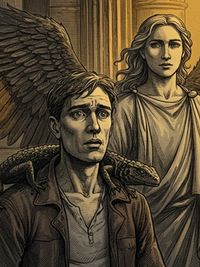
The most powerful moment in the book, for me, is the ghost with the lizard of lust on his shoulder. An angel offers to kill it, but the ghost hesitates. The lizard whispers that it's not that bad, that he can manage it, that killing it would be too painful. The angel waits patiently, offering the same choice again and again. Finally, the ghost consents.
And the moment he does, everything changes. The lizard is killed, but it doesn't just die—it transforms into a magnificent stallion. The ghost himself becomes solid, real, fully alive. What he thought would diminish him by its loss actually completes him. What he feared would destroy him actually saves him.
That's the pattern of the Cross. That's the pattern of every saint's life. That's the pattern God is trying to work in me, if I'll let Him.
I think about this every time I'm faced with a choice to surrender something to God. A habit I don't want to give up. A comfort I'm afraid to sacrifice. A way of thinking I've defended for so long I can't imagine letting it go. In those moments, I'm the ghost with the lizard, and God is the patient angel, offering me the same invitation He's been offering since the beginning: Let me kill the thing that's killing you. Let me transform what's twisting you. Trust me with this.
The scary part is that I have to say yes. God won't force it. He respects my freedom too much to save me against my will. Lewis is clear about this—the damned are successful rebels to the end. They get exactly what they wanted: themselves, and nothing else.
But the beautiful part is that when I do say yes, when I do surrender, I don't lose what I thought I would. I gain everything. The things I was clutching in fear are transformed, purified, made more real and more beautiful than they ever were when I was trying to protect them from God.
My marriage works when I surrender it to God's design, not when I try to shape it according to my comfort. My kids flourish when I prioritize their holiness over their happiness, trusting that God loves them more than I do and knows what they need better than I can imagine. My own soul comes alive when I stop trying to negotiate with God and just say yes to whatever He's asking.
The Great Divorce is Lewis's reminder that this is the only choice that really matters. Every other choice—what job to take, where to live, how to spend our time—flows from this one. Will I say to God, "Thy will be done"? Or will I insist on my own will until God finally, sorrowfully, says to me, "Thy will be done"?
I don't want to be a ghost in the Grey Town, clutching my little idols and defending my little sovereignty. I want to be solid, real, fully alive in the presence of God. I want to be the man who says yes to the angel, even when it hurts, even when I'm afraid, even when I can't see how it could possibly be good.
Because every time I've managed to do that—every time I've surrendered something I was sure I couldn't live without—I've discovered Lewis was right. The thing I thought would diminish me completed me. The thing I thought would destroy me saved me. The pain I feared was the labor pain of new life.
That's the Gospel. That's the promise. That's the invitation God extends to every one of us, every moment of every day: Choose Heaven. Let go of Hell. Say yes to My will, and discover that My will for you is infinitely better than anything you could want for yourself.
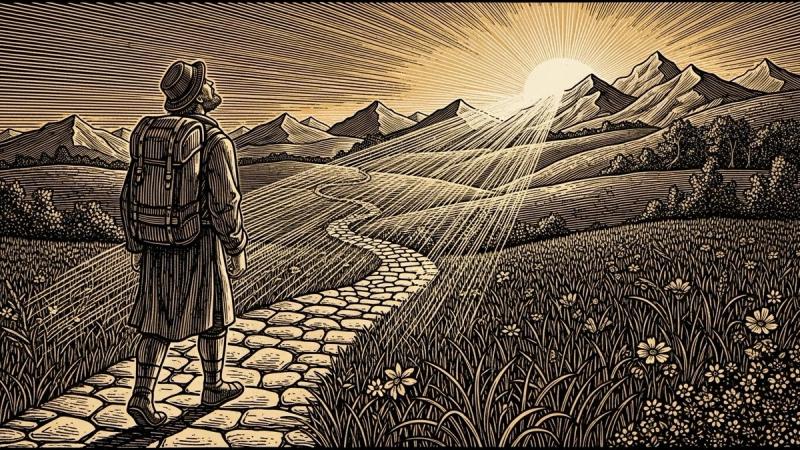
The bus is waiting. The sun is rising. The choice is ours.
Thy will be done.
Your feedback helps us create better content