ARTICLE
The Great Divorce: The Freedom to Choose Heaven
Hell’s doors are locked from the inside. We’re free to choose Heaven—if we let go of our idols and say, ‘Thy will be done.’
November 2025
Meeting Date: 11/17/2025
By C.S. Lewis
Eschatology: The Four Last Things
C.S. Lewis's theological fantasy explores the nature of heaven, hell, and human freedom. A profound meditation on the choices that lead us toward or away from God, and the reality that the gates of hell are locked from the inside.
All who die in God's grace and friendship, but still imperfectly purified, are indeed assured of their eternal salvation; but after death they undergo purification, so as to achieve the holiness necessary to enter the joy of heaven.
- Catechism of the Catholic Church (para. 1030)
We cannot be united with God unless we freely choose to love him.
- Catechism of the Catholic Church (para. 1033)
Out of all the novels on the list, THE GREAT DIVORCE is the only explicitly Christian text. It is a beautiful imagining of the afterlife, where author C.S. Lewis posits the particular judgement of each person as a final choice. We are not told whether we "made it" to heaven or not. At the end of our lives, we are instead given a choice: face the demons we ran from and the work we didn't do on Earth, or keep running. In other words, we have to face whether we really want God and why we rejected him.
The novel presents the choice as a multi-layered series, experienced by an unnamed protagonist who comes to in a strange space, having no idea what happened to him. Eventually he realizes he has the option to wait for and then board a bus. That's the beginning.
The choice of whether to get on this bus is not really understood-the narrator can only be motivated by vague curiosity, or even just a desire to stop feeling confused and afraid. This has nothing to do with real moral understanding. It is not a genuine capacity to choose God. Still it is a solid beginning to at least be curious about the nature of your condition and what is going on, which is further than some of us ever get. Lewis' depiction of Napoleon demonstrates what a totally self-obsessed lack of curiosity looks like-Napoleon can only stalk about a room, endlessly and ragefully thinking about who to blame for his military failures. This kind of resentment and preoccupation of ego is so overwhelming that Napoleon will never be able to escape it long enough to even look up and wonder where he is. This is how he is doomed to live for all eternity. There isn't even enough self-awareness to know he is condemned. Its just blind, ugly misery. You can't talk about God to a person like this.
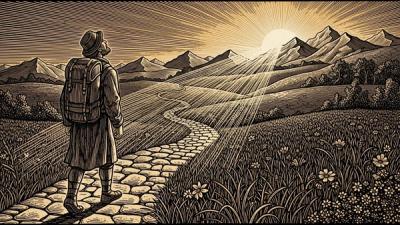
For those who are at least able to escape the ego enough to get on the bus, there are more choices. Many don't even make it to the destination. But the narrator manages to get to a strange naturescape where he finds himself transparent, and so weak that the blades of grass cause terrible pain and damage to his feet. In this space, he meets many other transparent ghosts with various backstories. Some are rabidly defensive; some are arrogantly defensive. Others are fearful, addicted, cynical. The ghosts are met by the spirits of people they knew in life-solid, strong, beautiful spirits that came down from the mountains specifically to help bring the new spirit back up with them. In order to make the journey, each ghost has to be willing to face why they turned from God, and what they chose instead.
With a dreamlike narration style, Lewis describes some painfully familiar ways that we run from God, choose other idols, and refuse to give up our ego and defense mechanisms. The narrator learns that the transparent ghosts become solid, larger, and stronger as they are willing to face themselves and grow in self-awareness. Eventually one can become fully solid and charge up the mountains towards God. It turns out, in Lewis' world, that the journey to heaven was heaven all along.
C.S. Lewis presents a vivid imagining of the afterlife and matters of eschatology: the teachings of the Church that relate to man's final relationship with God, including heaven, hell, purgatory, particular and final judgments, the resurrection of the body, and the new heaven and earth. Since The Great Divorce is explicitly Christian, we don't exactly have to hunt for Jesus in the themes. Instead we can dive right into the theology, particularly how the story presents excellent support for Catholic teachings on holiness and purgatory.
General judgement is what will happen when Jesus Christ comes back and judges the living and the dead. That involves the fate of all humankind. But the particular judgement is about our individual lives and choices. It is when our lives are examined before God. THE GREAT DIVORCE centers around this matter of particular judgement. We don't know if particular judgement will look like God doing the accounting of our lives, or whether, like in Lewis' imagining, the particular judgement is about our ability to honestly look at ourselves. Both options (or some combination, or other circumstances) are valid. The important part is that this is a transparent assessment. There is nothing hidden from God, there is nothing we can hide from ourselves. Lewis presents a wrenchingly gentle and generous God who gives man the agency to perform his own particular judgement and choose for himself where he would like to end up.
God is not a cruel entity sending people to hell against their will because they failed to be good enough. God wants us to choose Him, and He gives every opportunity in life for us to do so. In THE GREAT DIVORCE, even the irrevocable final decision is entirely a matter of our choice. The use of a "pre-purgatory" gives us the option to condemn ourselves without ever being examined, if we so choose. No one ends up in hell unless they want to be there. Hell isn't imposed, but eagerly desired. Lewis describes a number of people who are motivated only by a desire to resist true self-examination. Being with God would not make them happy, and they are not forced to do it.
THE GREAT DIVORCE offers a rich exploration of the concept of purgatory. The ghosts have a choice to not only go through the purgation process, but can also change their mind and turn around at any time. Hell is not a one-time choice, in Lewis' imagination. If the purgation gets too uncomfortable, it is always possible to change your mind. It is unclear how that squares with basic Christian theology, where the final choice after death is irrevocable. But there is an interesting logic to THE GREAT DIVORCE-the ghosts that change their mind do so at the beginning of their journey, technically before they even begin. Those ghosts simply confront what purgation would involve, and decide to decline. They don't actually start the process. They decide for various reasons that if they can't deny, rationalize, bully, or justify their way out of things, they'd rather leave.
Those who stay and go on are a different case. In the novel, this willingness to open up and face oneself causes their physical nature to change. They can't go back-you cannot unlearn what you know. In this sense, self-knowledge gained by healing of the spirit is permanent. Our cooperation with God's work cannot be undone. It can only be built upon. At that point the only question is how much further the pilgrim wishes to go-the way to God, or not?
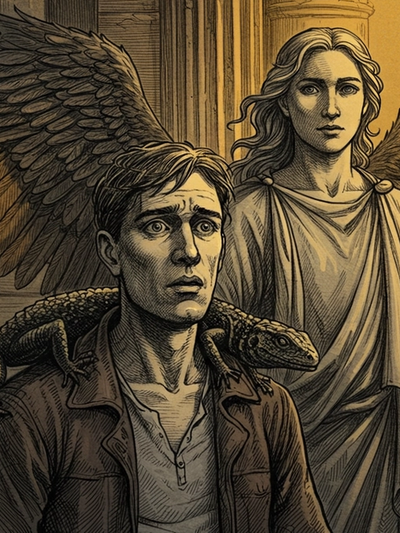
The most thought-provoking part of THE GREAT DIVORCE is that none of the ghosts are confronted with any facts, truth, or growth that they couldn't have encountered during life. So why wait until death? After all, in the novel God does not send His angels to walk the ghosts through their purgation. He sends fellow human beings, friends and relatives. The people who get us to heaven are those that know us quite well. They're not supernatural beings, but fellow people with the benefit of having gone through their own spiritual work. No one is holier than thou. No one who made it to heaven has done anything that we aren't all capable of doing.
The novel ends with a pressing emphasis on this matter-all these moral issues could be dealt with right here, right now in this life. The particular judgement can be done nightly in an examen, if we so wish. We have access right now to loved ones that can help us with this purgation. The most thought-provoking part of the stories of the ghosts are the familiarity of their sins. If we know we will have to do this kind of healing anyway, why do we not do so right now?
THE GREAT DIVORCE is ultimately a great argument for Catholic teachings, ironically from the pen of the non-Catholic Lewis. It is a powerful argument that our life on earth is for our growth in holiness. Salvation is not a one-time judgement, but a process of being healed, refined, and prepared. As we discussed in The Martian, even before the fall, Adam and Eve were not ready for divine union. They were gifted with the opportunity to participate in competing their own creation. Being forgiven and saved from the damnation of original sin is not sufficient, in Catholic theology. In other words, coming to Jesus is and being saved is not a "one and done" deal. It is a "one and begun" journey. We are now on a path of healing, growth, and preparation. THE GREAT DIVORCE shows how necessary this healing is, and how unprepared a person is to truly encounter God before undergoing this work.
The novel also persuasively argues for the logic of purgatory. If the process of becoming is not completed during our lives, then it must be completed in the afterlife. It makes little sense to think we would go straight to heaven to sit in the presence of God while still twisted by sin. God is not illogical. Most people do not die in a state of spiritual completion/sainthood. We need more work. Why would God either deny or ignore that? For those of us committed to this pursuit of holiness, it would be a great pain to see that process end before it is finished. At a certain point, you begin to anticipate and welcome the self-examination and healing, even though it is painful. The rewards are just too good. If heaven is a state of perfect self-awareness and the final goal of purgation, then there is nothing more desirable than seeing it through.
The characters in THE GREAT DIVORCE that commit to the pain find themselves in love with the process of becoming. There is no way they could have imagined the person that emerges from the ashes of refinement-the person that God made. The joy of the "end" is that it is truly the beginning of eternity with God, as our fullest and most alive. If we commit to this end, we do indeed find that it was heaven all along.
1. The characters in THE GREAT DIVORCE are all, to varying degrees, trying to hide the ways they deceive themselves and run from God. These cases of self-deception have a surface acknowledgement, along with a deeper, hidden motivation behind their choices. Why do you think people are so often willing to create a false picture of their sins instead of look at the truth? Is it really less painful? Why or why not?
2. Which character stories did you find the most compelling and relatable? Why?
3. THE GREAT DIVORCE holds that once we attain holiness and heaven, it will work backwards and "turn even that agony into a glory." In other words, the final perspective works backward to sanctify everything, including the sin and suffering we experience. Does the eternity of the future actually work to contextualize the past? Have you experienced this backwards-working in your own life? Do you think this is an accurate understanding of heaven? Why or why not?
4. The ghost characters are helped in their journey by friends and loved ones, some of which they would not have personally chosen to interact with. What is our role in getting our own family members and friends to heaven? What do we owe to each other in this life as Christians?
5. In the "grey-town," the inhabitants can create new homes and streets just by imagining them. There is no community or need to interact with others. Why do you think that Lewis imagined hell as a place with no community or relational qualities, but heaven as a place where only relationships can help us move upwards?
Sign up to receive study guides and participate in our monthly book discussions!
Join the Book Club