"The Antichrist's deception already begins to take shape in the world every time the claim is made to realize within history that messianic hope which can only be realized beyond history through the eschatological judgement. The Church has rejected even modified forms of this falsification of the kingdom to come under the name of millenarianism, especially the 'intrinsically perverse' political form of a secular messianism."
- Catechism of the Catholic Church (para. 676)
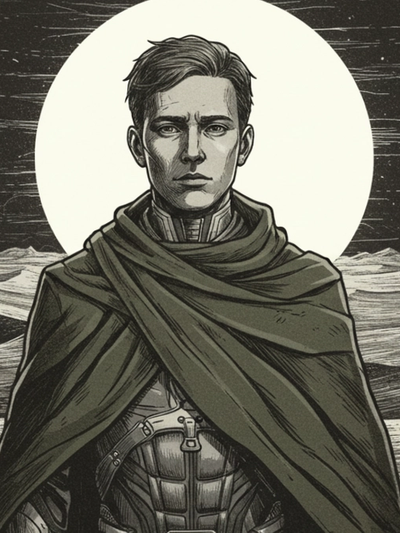
Frank Herbert's DUNE, of all the books on the list, contains the most evocative Catholic tropes. It's almost like Herber created a sequel to the New Testament set over twenty thousand years into the future, with all genuine metaphysical elements removed. The story of DUNE treats the New Testament as a precursor for the purpose of showing how the events have been foretold, to bolster the use of man-made prophesy.
The most accurately Catholic construct of DUNE is Herbert's expert use of typology to help the reader see the inevitability of Paul Atreides as the Messiah, the Kwisatz Haderach. Typology is how the Magisterium teaches Biblical interpretation-it refers to the use of foreshadowing as a narrative device. Without typology, it is pretty much impossible to understand the Bible as a single, coherent narrative. Herbert uses the method to create his own pseudo-spiritual mythology.
The use of typology in the Bible is best described by a common expression: the New Testament is concealed in the Old, and the Old Testament is revealed in the New. The events and peoples of the Old Testament are set up to be fulfilled in the New Testament-they are signs of what is to come, so that there can be no mistake when the messiah appears. For example, the ark of the covenant is a prefigurement of Mary. Joseph of the Old Testament, born of Jacob and protector of the bread in Egypt, prefigures St. Joseph the foster father of Jesus, born of Jacob and protector of the living Bread that flees to Egypt for safety. The manna that rains down from heaven to feed the Israelites in the Old Testament is a prefigurement of the Eucharist, the food that came down from heaven in the form of the body of Christ. The Ten Commandments of the Old Testament are a prefigurement of the Beatitudes, which fulfill and fully illuminate the law.
Prophesy goes hand in hand with prefigurement. The prophet points to the signs that must be watched, and explains the meaning. In the Old Testament, the Lord uses the prophets to prepare us the plan of salvation, so that we may know when the appointed hour arrives for the coming of the Messiah Jesus Christ. The prophets narrate the typological story, often by pointing out the allegorical or anagogical implications of the current events, and pointing us beyond the surface. It is not really possible to understand what the prophets of the Old Testament are saying unless you see that they are setting up how everything points to the New Testament.
In DUNE, Herbert creates a world where the New Testament conceals the Ultra-New Testament: the promise of a materialist messiah. The Kwisatz Haderach is the creation of human efforts; the second coming is not of Christ, but his human successor. In this world, the sophistication of technological advancements has been a dead end. Apparently by twenty thousand years in the future, we humans will discover that AI fails to deliver the kind of results we were hoping for. The most superior and enduring superpower is the human intellect, developed and enhanced to godlike status that surpasses the abilities of any technology we could create. Our savior is the human intellect, enhanced to wizardry: the super-man.
Various "guilds" of human collectives harness and exploit the human intellect in their own ways, to acquire political power. Each guild has its own trademark manner of shaping the abilities of the members via extreme conditioning and pharmacology. In the case of the messiah, the all-female Bene Gesserit guild use these methods, along with artificial prophesies of their manufactured religion, to commence a program of genetic and social engineering. Their goal is to create a male who can harness access to the male and female psyches of past ancestors (as opposed to the Bene Gesserit sisters, who can only access the female), and ultimately be able to see the future. This prescient power assures an insurmountable advantage of political leverage for the Bene Gesserit. Beneath the dogmatic language, mysticism, and exploitive use of religious overtones, this is ultimately about worshipping the end result of performance enhancing drugs, rigorous training, and extraordinarily social manipulation. God doesn't play a part in this fantasy except to be supplanted by the ascendency of the man-made order.
But in order to make the new-new messiah legitimate, DUNE uses the story of the actual Incarnation as the prefigurement, so that the reader may recognize the Kwisatz Haderach (even as the Bene Gesserit, like the Pharisees, fail to pick up the clues until after the fact). Some examples:
-The genetic lineage of the messiah is carefully documented on the side of Paul's father, Duke Leto, just as the genealogy of St. Joseph is painstakingly detailed back to Abraham. But the genealogy of Lady Jessica is shrouded in secrecy, as the Bible does not detail the lineage of the Blessed Virgin Mary. Jessica has been raised in the Bene Gesserit schools since she was a young girl; tradition holds that Mary was raised in the temple since childhood.
-The Holy Family is used as a prefigurement of the new "Holy Family" of Paul, Duke Leto, and Lady Jessica. In the Scriptures, the marriage between Joseph and Mary is specially arranged to be unconsummated so that Mary stays the faithful spouse of the Holy Spirit. In DUNE, the inversion is that Duke Leto and Lady Jessica's union is specially arranged to be illegitimate so that Duke Leto can stay faithfully open to a possibility of political partnership.
-In the Scriptures, the Incarnation happens because Mary gives her fiat to the Lord. In DUNE, Paul is born because Jessica gives her 'anti-fiat" to the Bene Gesserit, and bears a son instead of the daughter she was ordered to produce. Jesus is the result of Mary's yes; Paul is the result of Jessica's no.
-In the Scriptures, the leaders of the temple are amazed as twelve-year-old Jesus reveals his theological genius and perfect knowledge of the law. Herbert uses this as prefigurement of Paul's perfect and prescient knowledge of the ways of the Fremen.
There are many more such examples, but this will do.
The important point here is that the prophesies of the Bene Gesserit are explicitly false-the Missionaria Protectiva is an intentional deception of superstitious messianic mythology on various planets. The Bene Gesserit exploit the natural religious tendencies of primitive native populations to create a cultural environment that favors their interests. Their real aim is not to tend to the signs and communications of the actual God, and await the coming of His Son. Instead the god they seek is perfect political control. They are engineering and awaiting birth of the individual they believe will serve as the perfect tool for that outcome.
There is some gray area about whether Paul is a creation of Bene Gesserit scheming, or perhaps whether the Bene Gesserit accidentally stumbled upon a population where some elements of the Fremen faith are actually real, and Paul is an actual messiah figure. This unresolved tension is the source of much of the internal battle that consumes Paul even as he ascends to power with the help of the Fremen who believe in him. Is he an opportunistic fraud, or is the messiah prophesy maybe just a teensy bit real? At least, maybe its real enough that he can safely submerge his identity into the role?
Of all the books covered on the list this year, DUNE is the most egregious example of the cynical exploitation of religion as a tool of political control. But unlike FOUNDATION or WATCHMEN, which explore how false prophets and false messiahs affect the target population, DUNE points the blaster the other way: How does this deception affect the person playing the false role? What does the abuse of spiritual authority do to the psyche of the cult leader? Does the false messiah end up drinking his own Kool-Aid?
The Superpower of Free Will
Paul is in a quandary. His very existence has been engineered by shadowy forces, outside of his knowledge or his will. He didn't ask to be born at all, much less to be a genetically engineered male child of a Bene Gesserit and a politically powerful Duke. He didn't ask to be trained as Mentat and Bene Gesserit; then taken to the planet Arrakis and fit the messianic mold that the natives had been expecting.
Paul's life has been set up long before he came into being. His hand was forced to play a very specific and vital role in history. He faces pressure to please his mother, who fervently wants him to step into the role of the Kwisatz Haderach, with the kind of guilt-laced, controlling, instrumentalizing pressure that only a mom can induce. He also wants very deeply to make his father proud and defend his legacy-to be a good son. And on top of all this, there is incredible ego gratification in soaking up the worship of the Fremen. There is incredible power to possess in being the One who controls access to the spice m�lange. The inevitability and the temptations are all around Paul.
But it is his choice, ultimately. All the plans, schemes, hopes, and dreams amount to nothing at all if Paul decides he doesn't want to give his life away to this manufactured destiny. After all, despite all the smoke and mirrors, the choice to be Kwisatz Haderach is artificial. Paul would have to agree to buy into the lie, and risk being engulfed by it. If he does, then all the worldly power and security he wants is at his fingertips. As Jesus was tempted in the desert, the evil one makes a similar offer to Paul in the desert.
But unlike Jesus, Paul is not necessarily aware of the other option. He could say no to this path that's been forced on him by human meddling. But it is inadequate to merely say no to what you don't want. What would he be saying yes to instead?
In DUNE, Paul is not explicitly given the options. But here in real life all of us have that freedom. We know that we could choose to put on the false self-dive into sin and deception, and gain relief from the psychological pressures imposed by others, as well as the possibility of amassing power over the material world. We also know it would trap us, as it trapped Jason Bourne. We know we become slaves to the false self. In other words, it is impossible not to drink your own Kool-Aid.
But is this really a choice? If you reject what the powers and principalities of the world have to offer, then it seems you're left as with nothing. A nobody.
Nothing could be further from the truth. The other option is to be with the Lord made you to be. There is a second, much deeper set of prophesies and engineering that has occurred in the life of every human being. Each one of us on this planet at precisely this time in history, in precisely these conditions, because a loving God created us as so. All manner of deviations from His plan have been accounted for-no matter what our ancestors chose or how unpredictably chaotic the circumstances, God made straight paths with crooked lines, all for the purpose of producing YOU. All human power-plays and worldly ambitions could ultimately only serve the true Plan: the plan of the One who made all things, including even the humans who scheme. The Lord's plan throughout the ages was prophesied in heaven, amongst the communion of angels and saints. They all foretold of the time when YOU would come into being, to fulfill the unique mission that only you were made for.
This story is true for each and every human person. We cannot grasp the infinite number of variables that the Lord beautifully wove, the summation of all human decisions to both obey and disobey divine command, making certain that it all culminated in the creation of each individual person at a specific time and place, to both do and be something special. Unrepeatable, indispensable, and irreplaceable.
So this is the real decision that Paul has to make, even though the universe of DUNE does not show the details of the second option. Paul can choose to accept being a puppet of the worldly powers, and thereby hope to wrest some of it for himself. Or he can reject it-he can refuse to exploit the Fremen and refuse to be a political pawn. He can instead choose true freedom, to be whatever God made him to be.
Free will is not so much about a choice between good and evil. It is actually a choice to keep it, or give it up in slavery. When a human person chooses evil, they no longer retain their free will. Sin is the last act of the will-the real person, the one with the choice, has died. The body is henceforth a corpse animated by outside powers that compel it to act to maintain the false self. When Paul chose to embrace the role of Kwisatz Haderach, he became enslaved by his own mythology. There was no longer a Paul Atreides. There is only an illusion created by the manipulation of the Bene Gesserit, and the desperation of the Fremen. There is nothing left of Paul to even enjoy the spoils of the political supremacy he was after.
That's the fate of the false messiah.
DUNE is a brain-assaulting, extravagant story of the death of identity, the submersion and dissolution of a free human being, Paul Atreides. He is replaced by the specter that caved to pressures and temptations, becoming a non-self in order to chase a kind of happiness that ends up taking control of him. It is a perfect description of what happens when we surrender our free will and walk away from the greatness that could have been ours in the Lord.