
VIDEO
C.S. Lewis, The Great Divorce, and a Retrospective of the 2025 Book List
What happens when you read C.S. Lewis's vision of purgatory through the lens of an entire year's worth of literature?
July 2025
Meeting Date: 7/28/2025
By Isaac Asimov
The Deposit of Faith
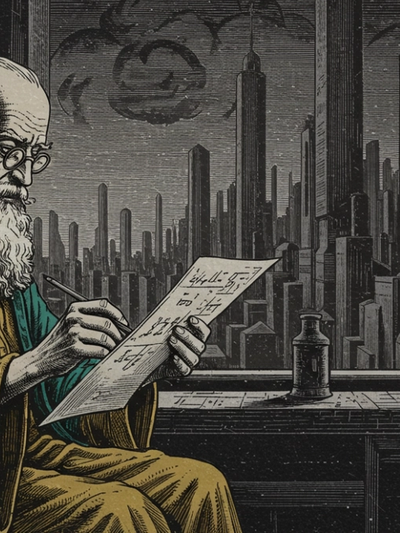
Isaac Asimov's galactic epic, inspired by the fall of Rome and the medieval Church, offers a profound defense of faith and the role of humankind in protecting divine revelation through dark ages.
As an Amazon Associate, we may earn a commission from qualifying purchases made through our affiliate links at no additional cost to you.
"A catechism should faithfully and systematically present the teaching of Sacred Scripture, the living Tradition of the Church and the authentic Magisterium, as well as the spiritual heritage of the Fathers and the Church's saints, to allow for a better knowledge of the Christian mystery and for enlivening the faith of the People of God. It should take into account the doctrinal statements which down the centuries the Holy Spirit has intimated to his Church. It should also help illumine with the light of faith the new situations and problems which had not yet emerged in the past."
- Fidei Depositum, Pope St. John Paul II
Isaac Asimov's FOUNDATION is widely regarded to have been inspired by the history of the fall of the Roman Empire and the role of the medieval Catholic Church. Asimov himself was an avowed atheist who had little patience for religious dogma, and his distaste for spiritual belief permeates the entire novel. So it is interesting that in FOUNDATION, Asimov ultimately offers a profound defense of faith, and the role of humankind in protecting the deposit of divine revelation.
How does an atheist end up creating such a religious work? First, let's look at history.
FOUNDATION starts with the Galactic Empire, over twelve thousand years old and in steep decline. The culprits are typical: political infighting, economic depression, stagnating intellectual advancement, the excessive burdens of administration of a too-large enterprise, and so on. By the time the prophetic God-like character of Hari Seldon comes along, the historical forces of destruction are too far along to stop. Instead Seldon starts the Foundation, a shadowy group whose proposed aim is to preserve the collected scientific, technological, and artistic knowledge of the human species so that it can be used to shorten the period of anarchy that will follow the destruction of the Empire.
The Foundation is exiled to the far corners of the galaxy, poor and defenseless, surrounded by barbarian kingdoms that have rebelled and broken away from the Empire. The Empire offers no protection. The Foundation must use two things to survive: its public face of friendly, neutral charity, and its private goal of reliance on the "science" of psychohistory. The true aim of the Foundation is to eventually found a new Empire that imposes political hegemony under their rule. This goal of galactic domination has been guaranteed as certain by their prophet Seldon, who assures them that according to the "science" of psychohistory-a special, fiercely guarded knowledge that they could not ever come to on their own-the new Empire has already won victory over the world. By following the plan of psychohistory, the men of the Foundation get to be co-creators in the plan for the new and eternal Empire.
Okay, now to real life: As the Roman Empire moved towards decline (for many, but not all, of the same reasons as the Galactic Empire) over the fifth and sixth centuries, the fledgling Catholic Church emerged as a source of charity for the poor, and administration of hospitals, schools, and other various social services. For its part, the Roman Emperors moved the seat of power from Rome to Constantinople, leaving the Western half of the Empire to fall into rebellion and rule by various barbarian kingdoms. The Catholic Church was small, defenseless, poor in material resources, and armed only with the power of the Holy Spirit-more or less abandoned to figure out for itself how to keep from being attacked and annexed by some local ruler. The Church must proceed with the plan, given by Jesus Christ, to spread the news of the Gospel and await the second coming where the Lord would take full possession of the Kingdom that already is. The Church has been assured that Christ has already won total victory over the world, and by following divine revelation-a special, fiercely guarded knowledge that human beings could never come to on our own-the Church would help bring about the new heaven and new Earth. But rather than getting to be rulers themselves, it is Christ that is at the head, and the faithful are his body.
In FOUNDATION, the small, strategically weak Foundation learns to play the various barbarian kingdoms off of each other. They offer their unique technological aid as spiritual food, installing a dummy religion with all the trappings of liturgy and a hierarchal priesthood. The Foundation appeals to the monarchs of the Kingdoms by offering to legitimize their rule as divinely bestowed. The various kingdoms quickly jump at the chance to secure their authority over their subjects with the help of spiritual control-which of course this is all ultimately under the control of the Foundation. The monarchs quickly realize that they are slaves to the Foundation, which has real control over the emotional devotion of the subjects. Every kingdom is full of people who have been manipulated into completely falling for this sham of a religion.
In real life: the fledgling Catholic Church sent out its missionaries Westward and negotiated with the various barbarian tribes and kingdoms, offering their spiritual knowledge. The enduring and powerful system of monasteries, led by fierce and intelligent monks including St. Boniface and St. Benedict, helped spread the message of the Gospel through the Roman Catholic tradition. The efforts resulted in widespread conversion to Roman Catholicism (and Roman cultural values), including conversion of powerful families in powerful tribes-notably the Franks. In time, the Roman Empire cast off the papacy and converged its focus on the Byzantine half, contemptuously throwing the Roman Church to the wolves. The Church decided to make inroads with the Carolingian family of the Franks, long seen as holding the real power in the kingdom. The Church eventually helped transfer official rule from the failing Merovingian dynasty to the more friendly Carolingians, joining forces to legitimize their rule with spiritual authority that the subjects believed in with fervent devotion.
Eventually, over the next millennia or thereabouts, the Catholic Church assisted in the development of the various nation-states of Europe, all ruled by monarchs that were crowned by the Pope. Their status as royalty ordained by God was dependent on the religious devotion of their subjects...and the religious devotion of their subjects was founded on an unshakable loyalty to the Roman Church. As we covered in the discussion of Ender's Game, over time this state of affairs caused some significant dissatisfaction for various rulers, who did not appreciate the stranglehold of spiritual power held by the Church, with their power to call strikes and control the masses. Rulers were limited in their actions to the extent that the Church had the authority to declare whether such actions were morally permissible, and therefore accepted by the subjects. Eventually the Wars of Religion resulted in a fracturing of the spiritual authority, with various rulers claiming the right to control Christianity within their own borders. The nations remaining loyal to the Catholic Church were in a position of significant leverage of the Church. The power of the spiritual sword in Christendom was not weakened, at least at this point, but rather broken and distributed to the temporal authorities. They divided his garments amongst themselves. The march towards the Enlightenment, the use of trade for conquest, and the eventual discard of state-sponsored missionary expeditions in favor of raw monetary dealings occurred not under the command of the Catholic Church, but rather by a diverse variety of numerous nations that took hold of the spiritual authority and did with it as they wished.
Now back to FOUNDATION: when the barbarian monarchs realized they had been had by a sham religion, their response was not to try to wrest the power of the spiritual sword for themselves. The Foundation maintains a vise grip control over the "faith" of technology-there is no way for the various kingdoms to take a hold of it and make it their own, outside of the control of the Foundation. The technology can only be operated by the priests of the sham religion. The various petty rulers of the hinterlands end up shunning the religion of the Foundation, banning missionaries and turning to their own various versions of ancestor worship. After nearly a century, the Foundation is only able to make inroads to establishing political control over barbarian kingdoms by discarding the false religion and turning to pure trade. This proves to be a far more successful approach to garnering the loyalty of the masses. People are far more attached to their economic and leisure conveniences than to their eternal souls.
By the end of the novel, Asimov has well made his point. Religion has historically been nothing more than a means of political control-and an archaic, primitive, and outdated one at that. In FOUNDATION, the leaders acknowledge that their sham religion had its early uses, but it is merely a means to an end of the establishment of total political power over the galaxy. And such an end is eventually better achieved through more sophisticated means. Only the foolish, na�ve, and ignorant really believe in a thing like "God." This kind of emotional manipulation of the masses must have an expiration date. The entire notion of faith is inherently tied to exploitation, and it is an ugly thing best dumped on the graveyard of history. The real power that saves is secular human intelligence, no metaphysical or mystical component need to be involved.
And yet the men running the Foundation are deeply devoted religious zealots of a level that few Christians could claim. Even as characters like Salvor Hardin and Hober Mallow sneer their contempt at the fake faith of the masses, they are slavish servants to the psychohistorical predictions of Hari Seldon. Even as they exploit the sham use of religion, they carefully guard, even with their lives, the real deposit of faith: the Vault where Hari Seldon's holographic speeches are given at various intervals to guide them through the sign of the times. They willingly submit their intellect and their will to obedience to Seldon's plan, based on an unshakable faith that it is true, and a hope that victory has already been won. These characters believe, wholeheartedly, that the information given to them by Hari Seldon is salvific, pure, essential to their understanding of the meaning of their existence, and containing perfect knowledge of their purpose. Their great honor is to play a role in Seldon's plan and use the information provided to participate as co-creators.
Of course this is perfectly understandable. The desire to receive and love the deposit of faith-information from God Himself-is written in our hearts. It is a part of our nature. An avowed atheist doesn't escape being a human person. Try as he might, Asimov cannot even write atheist characters who do not believe in, serve, and guard a truth outside of themselves. If he succeeded, his creations could not be human.
The issue then is what kind of truth is the subject of one's faith. In the case of FOUNDATION, the characters direct this faith to the god of human intelligence. Atheists are in fact full of faith, in that they have an irrational belief that human intelligence and efforts will save the world. They believe this not in the absence of any evidence, but in fact despite all evidence to the contrary.
Human intelligence is a beautiful thing, but as was discussed with Jurassic Park and chaos theory, our intellect cannot handle the complexity of the universe. We simply lack the capacity, no matter how many of our brightest and best put their heads together, or what kind of advanced tools we create-we cannot do it. Only God, the divine intellect, has this capacity. Our desire to predict the future (or even understand the past or present) is a doomed attempt to control it. Every single time we try we come up short. It's not that our intelligence isn't good for anything. But it is not up to the task of saving humanity.
But the Lord does not make us try to save ourselves-we have received thousands of years of divine revelation. He even sent His own Son and spoke to us directly. He created a Church that guards the knowledge, the deposit of faith. Even as civilizations rise and fall, as generations go astray, as cultural mores fall towards decay and sin, as confusion reigns.... the deposit of faith is there. We never have to reinvent the wheel to figure out who we are, why we were created, what we are supposed to do with our lives, how to live with ourselves and others in this life, and how to get to the end goal. Our salvation is assured by the gift of information that we are completely incapable of coming up with ourselves.
But the atheists of Foundation? They put this immeasurable trust not in the divine intelligence, but in a fellow human being. Certainly Hari Seldon is written to be an unprecedented genius. But this is a misplaced worship of human intelligence. The characters of FOUNDATION do not believe they could even recreate the scientific field of psychohistory without Seldon-why not? What sense does it make to believe that one human being can unlock levels of mathematical expertise that no other human can or ever will achieve.... but then claim that belief in a divine intelligence is a silly superstition? Why elevate a human being to God-status, but deny the real God? Seems a lot more sensible to just recognize the real God, so that one can be free of surrendering his will and intellect to another human being.
At the end of the day we are not condemned to live in the world of FOUNDATION, where political intrigue and slavish worship of fellow human beings is considered wisdom, but faith in God is foolishness. We do not have to put this kind of trust in mere human beings. The deposit of faith is real-we have Sacred Scripture and Sacred Tradition, and it is guarded and interpreted to guide us through every age by the Magisterium. In two thousand years it hasn't failed yet, which is quite a bit longer than the most anyone ever expected of old Seldon.
1. FOUNDATION presents the interplay between Church and State as one where the State controls the Church like a puppet. On the other hand, modern atheists and secularists hold that the Church used to control the State as a puppet, and everything should be done to avoid that outcome. What do you think is the correct relationship between the Church and State?
2. Is there an appropriate role for studying the psychology of various societies for any predictive purposes? Should we be trying to predict future events? Why or why not?
3. Which of the five stories in FOUNDATION are your favorite? Why?
4. The Foundationers keep their real faith (the Vault and Seldon crises) secret from the general masses, and instead create a false religion to control outsiders. What if they had shared their genuine faith from the beginning? Do you think it would have worked better to spread this "Gospel" rather than a false faith? Why or why not?
5. Do you think there are parallels to how we deify technology and "tech wizards" today as capable of saving the human species? What kinds of parallels do you see? Do you think these are good or bad developments? Why?
What happens when you read C.S. Lewis's vision of purgatory through the lens of an entire year's worth of literature?

How the family serves as the cornerstone of faith transmission and civilization itself.

Isaac Asimov's Foundation series examined through the lens of Catholic philosophy and theology.

Introducing our 2025 reading challenge and how every great book can be read through Catholic eyes.
Sign up to receive study guides and participate in our monthly book discussions!
Join the Book Club