
ARTICLE
The Masculine Art of Listening: Lessons from Pride and Prejudice
Tyler Woodley explores what Jane Austen's masterpiece teaches us about attentive listening and authentic masculine virtue.

April 2025
Meeting Date: 4/28/2025
By Jane Austen
Virtue and the Sacrament of Marriage
Jane Austen's timeless romance explores virtue, the sacrament of marriage, and the formation of character. A beautiful reflection on how pride and prejudice can blind us to truth and love.
"St. John Chrysostom suggests that young husbands should say to their wives: I have taken you in my arms, and I love you, and I prefer you to my life itself. For the present life is nothing, and my most ardent dream is to spend it with you in such a way that we may be assured of not being separated in the life reserved for us.... I place your love above all things, and nothing would be more bitter or painful to me than to be of a different mind than you."
- Catechism of the Catholic Church (para. 2365)
Well, St. John Chrysostom, that sounds beautiful, but what if husband and wife are of the same mind in being equally terrible?
The Lord, of course, offers us an answer: the goal is not for spouses to sink to the lowest common shared denominator. That is the essence of marriage as a sacrament: our minds and characters change continuously-the tether of marriage propels that change upward, encouraging the other to grow in virtue towards Christ. Wherever there is a gap between husband and wife, the one who is closer to the Lord selflessly and tirelessly works to lift the other up. To commit to being of the same mind is to commit to a personal journey of elevating one's mind toward the person of Jesus Christ, and never ceasing to spur the other to do the same. This is the true purpose of marriage: a virtuous, upwards cycle of holiness founded on the covenantal unity of mind and heart.
The goal is not only to be of one mind as husband and wife, but to see evidence over time that this unity has resulted in two people who have grown in character together-having achieved a level of holiness together that neither could have done alone. A husband and wife should make each other better people.
In PRIDE AND PREJUDICE, the Anglican Jane Austen may in fact have created the most stirring treatise in existence on Catholic marriage. She does this with the most straightforward teaching style: three bad examples of marriage, and the influence of all these examples on the central characters of Elizabeth Bennet and Mr. Fitzwilliam Darcy. The bad examples are Lydia and Wickham, Charlotte and Mr. Collins, and, painfully, Mr. and Mrs. Bennet. Each of these couples and their influence on Elizabeth and Darcy need to be explored to fully understand the masterclass in marriage that is PRIDE AND PREJUDICE.
Lydia and Wickham: A Lust Story
The obviousness of this "bad example" is part of the appeal in the genteel world that Austen creates. Wickham is a superficially charming sociopath. He uses his looks and easy social graces to create an illusion of gentility that makes the listener want to be fooled. What sort of virtues are these? Has this man developed self-control, patience, kindness, self-sacrifice? He is obviously a predator, looking to see what he can get out of any young lady that is unlucky and/or unscrupulous enough to take what he offers: fleeting attention based on the degree to which she can give him gratification. As far as marriage material, Wickham is a pass.
So why does Elizabeth fall for it? Because her ego was hurt. She needed the attention in the moment, and it was coming in strong from a man not only willing to make her feel attractive, but also happy to denigrate the character of the man who slighted her. Of course there is a tradeoff of turning to a man like this for validation. You end up as dependent on him for your own sense of self-worth. And after a while, being used comes to feel better than being loved. It got so bad that even when Wickham dumped her for not being wealthy enough, and quickly turned to more gratifying prey, Elizabeth made excuses for him. She quickly looked to denigrate her financial position as so obviously deficient that one could hardly blame him.
Her experience with Wickham did indeed result in the two coming to the same mind. Elizabeth's had to be lowered to match his.
Wickham's subsequent marriage to Lydia is a bit of a clich�-the shotgun wedding of two immature, amoral, gratification chasing louts, only concerned for their pleasure in the moment. The marriage is a sham and everyone knows it. Despite the desperate beliefs that the wedding would at least cure the social damage they caused, no one entertained any belief that Wickham would help Lydia become a good person over time, or vice versa. But they could certainly help each other become worse.
Was this a marriage that honored the institution? No-this is a classic example of the kind of marriage that the Catholic Church would declare invalid. There was significant pressure to marry, including the use of financial inducement. One could hardly say there was freely given consent on both sides. Neither party had the requisite intentions of chastity and fidelity, nor the mental understanding of marriage as a lifelong, indissoluble bond that the Church requires. Nothing about this marriage met the criteria set by the Lord, who elevated the bond to a sacrament.
Wickham and Lydia are a perfect example of a nominally Christian society that is so intent to save face and maintain conventions that they are willing to completely degrade the institution of marriage. Even the social understanding that Lydia was ruined for any respectable marriage is a tacit acknowledgement that marriage isn't about love-it's about a quid pro quo exchange to maintain hierarchy. And sometimes it's also useful for brushing sin under the rug. Who cares if two people, exclusively concerned with how to use each other for maximum personal gratification, get married? They can hide that shared lack of virtue in their marriage, which is the "right" thing to do.
This is precisely why even if the genteel English upper class of the early nineteenth century thought a marriage under such circumstances was necessary and morally proper, the position of the Catholic Church would have recognized that a marriage between Wickham and Lydia would be insulting to the parties as well as to the institution.
Today's modern view of marriage as merely a device for two people to consensually use each other for pleasure-and that such a bond should last exactly as long as the pleasure is flowing-arguably stems exactly from this seemingly "respectable" use of marriage as a vehicle to enable such mutual gratification. Each party is reduced to an object that exists only to use and be used, and a successful marriage is one in which each party can joyfully point to how the other provides those good sensations. The modern cultural understanding of marriage is really a natural evolution of the hypocrisy of Austen's era, just without the pretense.
But this is not God's design, as Austen beautifully demonstrates. No one is more pained by this degradation of marriage than Elizabeth, who had to personally confront her own willingness to use and be used by Wickham. This kind of bond is ugly and poisonous. Even if Elizabeth previously thought herself immune to ever falling into the kind of sin that Lydia chose, she undoubtedly was tempted by the mindset to be drawn to someone for the purposes of gratification. Had Wickham not dumped her first, who knows how the beloved character of Elizabeth Bennet would have devolved? How many of us are truly immune to such sin, especially if we are in the closest company of those who would encourage it?
Charlotte and Mr. Collins: Eww
That leads to the second bad example of marriage: the embarrassingly transactional nuptials of Elizabeth's friend Charlotte Lucas, to Elizabeth's' cousin Mr. William Collins,
Now this is a marriage done right, according to every social convention in the world of PRIDE AND PREJUDICE. The parties of course agree to marry before living together. Both are, presumably, chaste and from good backgrounds. Mr. Collins has an established living and is well able to provide for a wife and family, and Ms. Lucas is a respectable woman who would make an excellent wife to a clergyman.
But there is the pesky matter of neither party having any feelings of love for the other. Mr. Collins proposed to Charlotte nearly instantly following his rejection by Elizabeth. But the particular woman involved makes no difference to him. His interest, which he states clearly in a letter before his arrival, is to find a wife much like one buys a car. A wife is a useful commodity and status symbol; he sees himself as generous enough to buy one at above market value, as a favor to his entailed uncle.
Charlotte for her part is merely interested in avoiding spinsterhood and being a burden on her family. If she can be properly married, she can claim status and keep a roof over her head. It makes no difference to her who she ends up marrying. A husband is as much of a commodity as a wife, and both parties are equally of one mind in their quid pro quo dehumanization of the other.
This is just as monstrous of a betrayal of the nature of marriage as Wickham and Lydia's sham arrangement. There is little to separate Charlotte and Mr. Collins' view of marriage from long term prostitution. Both parties are simply after what they want, and willing to use the other to attain it.
Certainly one could argue that what they want is sensible-not merely ego gratification, attention, or sexual access. Both Charlotte and Mr. Collins want a home and family, and there is nothing wrong with that. Those are good things to want. Marriage is exactly the correct vehicle for establishing a home and bringing children into the world. And of course a reasonable concern for financial stability is not mercenary. One must live in the real world, and women are concerned with choosing a husband who can demonstrate a capacity to provide. This is important for the sake of the children that would be created from the union. By every measure including that of today's world, it seems unfair to criticize two people who are doing things the "right" way to get the "right" things.
The problem of course is that the desire for a spouse and family can easily become an idol that is misused and twisted into self-serving purposes. Depending on the social context-whether nineteenth century English high society, or a modern-day conservative parish community-there can be major hierarchal rewards for getting married and having children. Those rewards can involve social acceptance, approval, a friend group, elevated status, and the ego gratification of seeing oneself as the "right kind" of person. The spouse and children are instrumentalized just as easily as humans can instrumentalize anything.
Likewise individuals who fall to this way of looking at marriage are just as guilty of commodifying themselves. Charlotte sees herself as a useful prop who can play her role of making Mr. Collins feel good and look good. She is painfully aware of her willingness to exploit herself to get a husband. Her goal is to find a man willing to settle for a plain faced spinster with little social or financial capital. She is aiming down, hoping to advertise her low standards as a selling point.
Mr. Collins on the other hand is shockingly ignorant of how he degrades himself, but just as culpable. Like the modern-day "incel," he is convinced that he has all the external trappings that a woman desires: a good income, a respectable profession, a home, and the right connections. Though he claims that he cannot fathom why a woman would not want him, he is careful to aim for women that he feels have a low enough market value that they ought to be grateful for his attention. His only goal is to avoid rejection. A wife ought to be as much of a guaranteed purchase as possible, for a man with no internal self-worth.
Are these the kind of people who enter into a marriage with the right formation and understanding of the sacrament? Do they truly love each other and commit to helping each other grow in holiness? Definitely not. When Charlotte hears Mr. Collins embarrassing himself in public, she pretends not to hear. Is she capable of loving him enough to gently discuss his behavior? Does she will his good enough to risk having an uncomfortable conversation that helps him improve in his character?
Why should she, when all she wants is the house, the income, and the status? Why rock the boat when the spouse is merely a means to an end? It is impossible for Charlotte to respect her husband as Scripture commands-her very willingness to marry him is a sign of her lack of respect for him. And it is impossible for Mr. Collins to love her as Scripture commands. He has no interest in her heart or her character, she exists to make him look good.
What kind of home life can be expected for the children that are the fruit of this union? How can these two individuals shape the moral worlds of those little ones, let alone help each other grow in virtue?
This is a bad example that Elizabeth-despite bearing just as much pressure to marry for the sake of status and money-refused to follow. But while her rejection of Mr. Collins proposal was admirable, it was also theatrical. She didn't truly know what she was refusing. It is possible that her mother's pressure, combined with time, and the witness of her elder sister being jilted, may have caused her to experience some anxiety and regret. Even if she had no selfish concern for her own welfare, it certainly weighed on her to be a burden to her father, or an impediment to the marriage of her younger sisters.
But the direct witness of Charlotte's decision was a concrete affirmation of her refusal to abandon the divine commands of love and respect in marriage. There was no pressure in her world to enter into a marriage like Wickham and Lydia's, but as Christians we often do need tangible evidence to help us refuse the pressure to conform to a "Charlotte and Mr. Collins" situation of surface-level acceptability. A bad example is at least good as a cautionary tale.
Mr. and Mrs. Bennet: Contempt and Missed Chances
The one kind of cautionary tale no one wants is the kind where your own parents are the bad example.
The most wrenching parts of PRIDE AND PREJUDICE are the scenes where Elizabeth must confront the flaws in the marriage of her parents, and how those dynamics have affected her.
Mr. and Mrs. Bennet did everything right. They courted and were married, and duly produced five lovely children. They participate in society and Mr. Bennet is known as a gentleman. That's about where the good story stops.
Mr. Bennet is a poor husband to his long-suffering wife. He openly mocks her, especially in front of his daughters, for sport. He has no interest in Mrs. Bennet's inner world, does not care about her fears and concerns, and does not feel any responsibility to correct her character defects. Mrs. Bennet is not necessarily a sympathetic character with her gossiping and socially inappropriate behaviors, but a wife deserves a husband that loves her enough to gently help her see the flaws to which she is oblivious. This would be for her good, to leave her spotless and blameless before the Lord. It is his responsibility to help his wife become holy. But Mr. Bennet cannot be bothered to do anything besides make fun of her.
Likewise, Mrs. Bennet's concern for her daughters is quite reasonable, considering that they really are in a bad spot if they cannot be married. Mr. Bennet shows absolutely no empathy for his wife, and in fact leaves her entirely alone to worry about their children. In this regard and many others, his failings as a father are clear to Elizabeth, who clearly wishes to look up to him. But Mr. Bennet doesn't want to make the effort to care, even when Elizabeth earnestly pleads with him to put some attention into his family and make some difficult decisions.
Despite Mr. Bennet's humorous and enjoyable persona, there is little that poor Elizabeth can glean for how a man ought to treat her. She gains nothing good from witnessing how her own father behaves towards his wife and children. She also has no example of how a wife should address the character flaws of her husband-how do spouses have constructive arguments and challenge each other? If a spouse is unhappy with the behavior of the other, what do they do about it besides engage in contemptuous mockery? How do spouses work together to be of one mind in regards to critical matters of parenting and family life?
The marriage of Mr. and Mrs. Bennet presumably would meet the Church's criteria for consent and intentions at the time of marriage. But one could hardly accuse Mr. Bennet of having a tenderness and concern for being of one mind with his wife, or committed to the command to raise up his children in the way of the Lord. The most understated grief of PRIDE AND PREJUDICE is that after a few decades of marriage, Mr. Bennet can only express a distant, sporting contempt for his wife. There is no example at home for Elizabeth to follow for how spouses are supposed to help each other grow in holiness. All she knows is that she must marry, and she will not do it for mere status or financial self-preservation. But what evidence does she have that marriage is supposed to be something more-the kind of loving, mutual, total self-giving that is beautifully described by St. John Chrysostom?
Elizabeth and Darcy: The Saving Power of Love
In this world of bad examples (including the superficial values of Mr. Darcy's social circle-no less mired in exploitation, status-chasing, hierarchy-establishing, and empty sentiment), here are two people who are suffering under the degrading norms and expectations of marriage that have been imposed on them throughout their lives. But they have so much on their side: both want genuine love. Both are willing to take risks that the world finds foolish. Elizabeth will not marry Mr. Collins even if she ends up an impoverished spinster. Mr. Darcy will propose to Elizabeth even if he scandalizes and upsets his entire social circle and upends an estate-combining scheme that has been set up for him since birth. They are daring, principled, idealistic, and passionate-a perfect match. How could two people like that not easily get along and figure it out?
Because they have no idea what they're doing.
For these reasons, the pivotal fight scene during Mr. Darcy's first proposal is beautiful, even though few might consider it as such. Elizabeth clearly explains her problems with Darcy's character and behaviors, and why she finds them unacceptable. What previous experience does she have that a spouse can make these kinds of difficult statements not as a jab of mockery, but an earnest statement of fact? When has she seen this happening in a constructive way, where the husband takes heed and actually works on himself to get better? Even though her goal was not to change him, she learned that it was safe, and in fact necessary, to express her needs and observations in a relationship. She learned that doing so does not end the relationship, if the other person has good character. And before this, no woman in Darcy's life had the strength to be honest with him and give him a chance to rise to the occasion by improving himself.
Likewise Darcy's letter to Elizabeth, given after their fight, was her first experience of having her flaws and mistakes respectfully pointed out to her by a man who cared enough about her to take the time. Darcy was not merely defending his own ego and reputation. His letter betrayed a sincere concern that Elizabeth not be deceived by a bad actor. He wanted her to know that her feelings and opinions matter to him, and he wanted to give her information to improve her judgement. Prior to this point, no man in Elizabeth's life had the strength to care about her for her own sake, and give her the opportunity to benefit from good counsel so she could grow as a person.
Even before the graces of the sacrament were in place, Elizabeth and Darcy, two people motivated by love and truth, learn the most important thing in premarital prep: how to have a good fight.
Honesty and genuine desire to help the other person change and grow, for their own sake, is not for the weak of heart. It's even harder when neither person has a particularly good childhood, or good examples to fall back on. How many people enter into marriage without ever daring to test their love with real communication? It can only happen when both parties are virtuous enough to approach each other with no ulterior motive in the relationship-no desire to use each other for gratification, no transactional mentality, no thought of status or social acceptance, no fears of being alone or impoverished or unwanted. If both people can get to that place of stripped-down self that seeks only to know, love, and serve the other, to will their good, to want the other for their virtues.... well then you can start to really talk about what it takes to make a marriage work.
Elizabeth and Darcy overcame incredible odds long before meeting again at Pemberley. Overcame bad childhoods and bad examples. They conquered their own egos. They can really know the other, because they helped create each other. And it is natural to love the one who prompted such transformation. This is the kind of love that calls both parties to urge each other to grow ever closer to Christ and each other-the genuine bond that defines marriage as a sacrament.
1. What do you think of Darcy's interference between Bingley and Jane? Do you think his actions were warranted as a good friend? Or was he wrong to do what he did?
2. PRIDE AND PREJUDICE does include one example of a good marriage: that of Mr. and Mrs. Gardener, Elizabeth's aunt and uncle. How do you think their witness affected Elizabeth and Mr. Darcy?
3. Do you think Darcy's decision to refuse to marry his cousin Anne de Bourgh, and propose instead to Elizabeth, and Elizabeth's decision to refuse Mr. Collins? Do you think these were realistic choices for people in an era where money and status were such a strong factor in marriage?
4. What do you think of Elizabeth and Darcy's willingness to self-examine and change as a result of their argument? What virtues play a role in spouses making each other better people?
5. While Elizabeth and Darcy both develop and grow as people, the characters around them stay fixed. How could characters such as Jane, Bingley, Mr. Bennet, and others mature as a result of the story?
Tyler Woodley explores what Jane Austen's masterpiece teaches us about attentive listening and authentic masculine virtue.
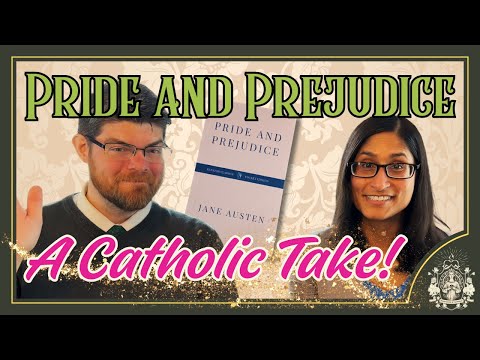
Jane Austen's beloved novel examined through Catholic understanding of virtue and sacramental marriage.
Sign up to receive study guides and participate in our monthly book discussions!
Join the Book Club