VIDEO
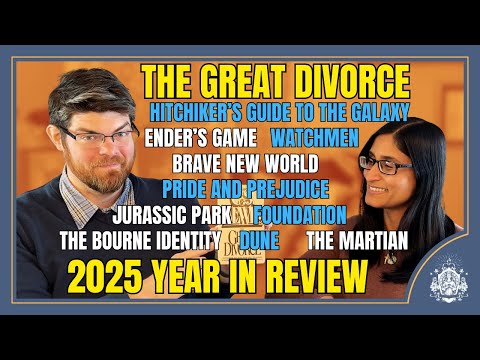
C.S. Lewis, The Great Divorce, and a Retrospective of the 2025 Book List
What happens when you read C.S. Lewis's vision of purgatory through the lens of an entire year's worth of literature?
May 2025
Meeting Date: 5/26/2025
By Aldous Huxley
Formation of Conscience, Kulturkampf
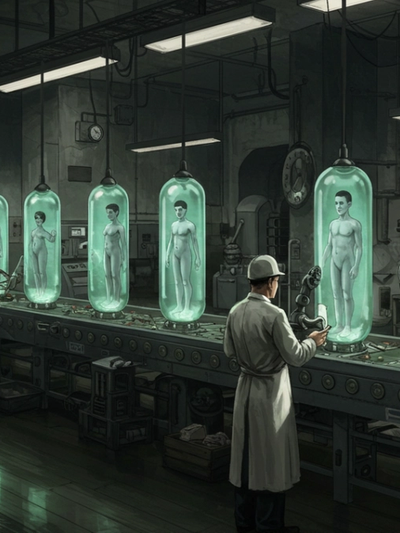
Aldous Huxley's dystopian vision presents a world where marriage, family, and human dignity have been sacrificed for stability and pleasure. A prophetic warning about the dangers of divorcing sexuality from its divine purpose.
As an Amazon Associate, we may earn a commission from qualifying purchases made through our affiliate links at no additional cost to you.
"In the formation of conscience the Word of God is the light for our path, we must assimilate it in faith and prayer and put it into practice."
- Catechism of the Catholic Church (para. 1785)
Aldous Huxley's BRAVE NEW WORLD is a perfect synthesis point of the texts covered so far this year: In THE HITCHHIKER'S GUIDE TO THE GALAXY, we discussed how the most logical way to get an answer about the meaning of life is to ask the Creator directly, rather than turning to elaborate man-made mechanisms. In ENDER'S GAME, we reviewed the Wars of Religion, and how Europe fractured under the ambitions of rulers who wanted to speak for God within their geographic borders. In WATCHMEN, the concept of God as Creator of the material world was so far divorced from daily life that the power to manipulate the material was good enough to claim god-hood. In PRIDE AND PREJUDICE, we saw the critical impact of how those moral rules apply as humans relate to each other, particularly in marriage. The wrong set of rules reverberate over generations and across whole societies and cultures. But even a single incidence of two people working to understand and apply the right set of rules-given by the Creator, and interpreted without any distorting filters-can result in miraculous healing and beauty.
It's worth it to take a moment here to appreciate the entirely improbable fact that Christendom ever existed. An entire continent (and then some) all pretty much collectively disposed of the inferior idea that a god was something that merely had control over material existence. They agreed that the only thing worthy of calling "God" is the One who created everything out of nothing in the first place. Then they agreed that this Creator had communicated through various prophets. They agreed that He came Incarnate and spoke directly to humankind about who He is, who we are, why we exist, and what we are supposed to be doing. And the final improbability was that enough of them agreed that God established a specific human institution that was exclusively authorized (and ultimately held accountable) to guard and interpret His communications. These agreements created the breathtakingly beautiful legacy of Christendom, the fruit of Jesus Christ and his apostolic Church.
Now of course everything happens under the will of the Lord, including the fact that these threads frayed as the agreements fractured-about five hundred years into the post-Reformation world, we see how each agreement has slowly come undone, beginning with the disintegration of Christian unity, then the rejection of Christianity itself as the truth, and finally with a questioning and dispensing of the whole notion that God, if He even exists, has communicated anything at all, and whether His Word should be trusted.
This is a story literally as old as humanity. It goes right back to the Garden of Eden when the serpent convinced Adam and Eve that God may have given them a set of playing rules, but He was holding out on the cheat codes. This God character, the serpent convincing argued, only gave humans a set of moral codes because He wanted them to stay ignorant and enslaved. Following those rules would get us nowhere-if we really wanted to be happy, have power, and even be like God Himself, then we need to ditch those repressive divine commands.
Every single time we have ever fallen for that argument-first from the serpent, and thence from all varieties of bad actors-it has always, unfailingly led to our ruin. To stray from God's rules does not result in freedom. The total opposite is true-we become slaves to our appetites, our fears, our impulsive, short-term grasping. We become addicted. Our anxiety makes us easy to control and manipulate. Other people, institutions, and even substances and habits easily gain power over us and can tell us how to live. Our new tyrants demand that every aspect of our existence conform to their dictates. Ask any alcoholic how much power King Alcohol has over his life and how it orders his priorities, and you get an easy example of what this kind of subjugation looks like. To stray from God's rules is to wander into abject enslavement.
God's rules, it turns out, are not the source of oppression that prevent us from having all the joy and pleasure and power that the world can give us. On the contrary-they are the famed "cheat codes" we have been looking for this whole time. Following God's moral code allows us to have true freedom. They enable us to be impervious to the temptations of the flesh; to overcome the tyranny of fear (of death, pain, loss, obscurity, etc.); to have an illuminated mind that can operate with foresight and eternal perspective. And the Lord gives us all the tools necessary to successfully navigate life, including the Sacraments. He makes sure the rules are guarded, that we have an ongoing institution to help us know how to apply them to any situation. He literally took on human flesh and sacrificed His own body and blood for us, so that we could join into his perfect body, share in his Resurrection, and have the eternal life and divinity that He always intended to be our due. This is how beloved we are to God. He has never once left us to flounder on our own, trying to make up our own stupid rules.
But God also doesn't force His information on us. We have a choice. We can reject Him if we wish. Formation of conscience is fundamentally about this matter of rejection or acceptance. It's not a one-time action. It is an agreement to enter into a life-long discipline of learning how to conform our mind to His will. We have to decide to embark on a journey to radically reorient our lives to the person of Jesus Christ, in every single aspect of our thinking, feelings, actions, and words. Forming the conscience is a process, a participation in a relationship with truth itself. This is the source of freedom.
In Brave New World, every single person who lives in the civilized world is a broken, dehumanized slave that exists only to serve the state. They are in the most grotesque and worst form of bondage-the kind that is sold as true freedom. Huxley does not merely create a world where people are permitted to do as they wish with their appetites, but instead he creates a world where it is immoral not to not to indulge them. An alternative set of moral rules are impressed upon each person from the moment of conception, dictating how they are to relate to themselves, others, the material world, and God. Each of these rules are designed to create beings with a moral compulsion to chase pleasure, produce, consume, and not think about anything else.
This absence of self or thought beyond the next indulgence of empty pleasure is a kind of dehumanization that could only come out of a horror movie. The people in Brave New World are not allowed to be people. They are objects that exist to use and be used, and particularly formed so as to be entirely insensible of the disgusting violation of their dignity. Nobody in this world is free at all. This is the tyranny of earthly "freedom," seen in painful clarity.
Kulturkampf and God as Relational Love
The de-formation of conscience, as it can be called, is particularly concerned with mutilating the human capacity for relationship. No civilized character in BRAVE NEW WORLD is capable of relating to another human being. They are radically severed from all human connection from the moment of conception. No romantic attachments are permitted, families are non-existent, and even the words "mother" and "father" and scandalous and obscene.
Why does Huxley so pointedly center the relational rules of the civilized world?
To understand the significance, it is necessary to understand that to be relational is the most basic fact of being human. We are made to be relational from the moment of conception, where we come into material existence within the body of another human being. To be a person is to be in relationship. Jesus Christ Incarnated as an infant in the womb of the Blessed Virgin Mary to show that God Himself takes on flesh relationally. This aspect of our being is not only inescapable, but also one of the ways that we are made in the image and likeness of God, who is relational as Trinity. To detach us from our relationality is to detach us from God as well as each other.
How human beings relate to each other, specifically how men and women relate to each other in union, is so fundamental that it was also God's starting point. All of human civilization, every aspect of how we live, how a society is shaped and what values are embraced or rejected, the very survival of the species-all of it depends on the foundation of the relationship between man and woman. The formation of our conscience-the moral code we decide to follow-in our unitive and procreative behaviors towards each other, are what either make us free human beings growing towards eternal life in Christ, or else condemn us to death and hell. Our attitudes and conditions around how we make and raise children spell the difference between thriving and extinction. Nothing is more important than how men and women relate to each other, in individual couples as well as in society as a whole.
And of course, whoever calls the shots on how human beings engage in marriage and family issues has supreme power over the entirety of a given population. This is far greater power than merely getting to tell people what to do with their money. Sexuality is the aspect of self that is the greatest expression of relational identity with self and God. If it is subjugated to a man-made set of rules, then the entire self is given away. It is no small thing to get to dictate what counts as "moral" in the sexual area, as the World Comptrollers in BRAVE NEW WORLD are well aware.
It may seem that Huxley created a practically absurdist dystopia with no basis in reality, but in fact the Church has experienced a number of instances where earthly authorities have made the same kinds of attempts to seize the power to control sexual and relational morals, and thereby subject the population to exist for the ends of the state.
One very notable attempt occurred from 1871-1878 in the Kingdom of Prussia, as Chancellor Otto von Bismark openly went to war with the Catholic Church over the right to dictate the morals of sexuality and family life. Bismark sought to unify a shaky, culturally and regionally diverse Germany under a uniform national identity. The need for this was obvious-power could not be consolidated with so many diverse allegiances, and the faithfulness of Catholics to the Church over the State was particularly threatening. Bismark engaged in a seven-year campaign of persecution specifically to push the Church out of its role in education, marriage, and family values. The goal of the state, under Bismark, was to promote its own sexual morality, particularly in state schools, so as to break the power of the Church in being the authority that Catholics turned to in forming their families and educating their children. This period of persecution was called Kulturkampf-literally, "culture struggle," a battle for the consciences of the laity.
Kulturkampf was a complete failure-efforts to shut down and nationalize religious orders, abolish clergy participation in the administration of schools, and nationalize ecclesiastical offices (among other persecutions and restrictions) had the opposite effect on the laity. The response was a massive backlash of support for their Church. Catholics doubled down on their right to follow their consciences-shaped by God's law-over civil authority, and they obeyed the Church direction to passively resist unjust laws. Eventually Bismark turned away from open persecution and sought another, more successful means to sway the culture: the creation of the first modern welfare state.
The carrot proved far more useful than the stick, as the implementation of incentives and social services effectively began to cause people to turn away from faith and towards state-run institutions that offered aid packaged with acceptance of the state-created secular moral codes. Catholicism (and Protestantism) did not have to be fought, but simply replaced with more enticing secular dogma, until its moral influence was so marginalized that it held no longer held meaningful political significance. In this way, God's moral code can be shoved aside and nothing stands in the way of the nation-state claiming the full loyalty and compliance of its citizens, whose collective conscience they now control.
The world of today is shaped by the results and influence of Kulturkampf. Of course Kulturkampf was not the first or last persecution of the Church-there is nothing remarkable about that. What this particular persecution is remarkable for is what happened after it failed: Typically this kind of event would result in widescale religious suppression followed by revolution. But in this case, Bismark pivoted away from the violence and instead dove into the formation of a state-sponsored moral code that directly competed with the Church for cultural control. Bismark set the blueprint for nation-states to follow in the ensuing centuries ever since. These are the grounds in which Huxley created BRAVE NEW WORLD, a future where the incentive-laced bid is so successful (of course, not without some application of standard genocide and persecution as well) that it completely stamps out Christianity and replaces God's moral code.
But there is something that Huxley misses that cannot be ignored-we already know that Christ has won total victory over the world. The Resurrection happened. There is no real way for human beings to erase the reality of Jesus Christ. Like in PRIDE AND PREJUDICE, we can go astray for many generations, even many centuries. But all it takes to cure this is a single man and woman who discover the truth of God's plan for love and marriage, and follow it with their whole hearts, freeing themselves from the bondage of sin. There is simply no way for the evil one to create conditions of slavery that man cannot escape by turning to God.
The end of BRAVE NEW WORLD is a cliff-hanger. Lenina and John the Savage recreate a mutilation of the Crucifixion. Does it spark the miracle that sets freedom in motion? In a world where Jesus Christ is truth, nothing could stop it.
1. The character of Helmholtz Watson is portrayed as intelligent, creative, and principled. He rejects the mindless pleasures of the civilized world. But consider his reaction to hearing Romeo and Juliet. Do you think he could experience the joy of knowing God? Do you think he is capable of giving or receiving love? Why or why not?
2. The citizens of the civilized world are cut off from all human attachment from conception. Considering that the Lord made us relational, as well as what we know today about attachment theories, do you think the conditions of BRAVE NEW WORLD could really create stable human beings? How do you think that extreme lack of attachment would really affect people?
3. The World State motto includes the word "identity." Do you think that the social conditioning of the various castes counts as an identity? Why or why not? How would you define an identity?
4. Which aspects of Huxley's futuristic predictions appear to be most prophetic to our world today?
5. Why is soma referred to as "Christianity without tears?" Are there parallels to how we use pharmaceutical interventions in the modern world?
What happens when you read C.S. Lewis's vision of purgatory through the lens of an entire year's worth of literature?

Exploring how Aldous Huxley's dystopian vision contrasts with the Catholic understanding of family and human dignity.

Huxley's dystopian vision contrasted with Catholic teaching on marriage and family life.

Introducing our 2025 reading challenge and how every great book can be read through Catholic eyes.
Sign up to receive study guides and participate in our monthly book discussions!
Join the Book Club